


Djamila Ribeiro criticizes false balance in journalism in debates on violence against women: “Giving disinformation a platform is a problem”
May 20, 2026




The Brazilian philosopher argues that false data must be challenged immediately and warns against the logic of social media, which turns outrage into free publicity.
In a video posted on social media, Djamila Ribeiro criticized false balance in journalistic debates about violence against women and misogyny. The post was prompted by the participation of psychoanalyst Vera Iaconelli and actor Juliano Cazarré in a GloboNews program last week. Djamila stressed that the problem is not inviting people with different views to take part in a public conversation, but placing well-founded arguments and false claims on the same level. She cited as an example Cazarré’s claim that, in Brazil, women kill more men than men kill women.
“I don’t think it is a problem when the media invites people who think differently to debate. That is part of the history of critical thinking; we live in a democracy,” she said. “The problem arises when we try to equate two people: one who brings valid arguments and another who brings disinformation and fallacious arguments.”
The statement made by the Globo actor was also reported by Folha de S.Paulo and echoed in other outlets as an example of false equivalence between the homicide of men and femicide, a specific crime committed against women because they are women.
“From the moment a person presents a fallacious piece of data, it must be challenged immediately; otherwise, journalism is contributing to the spread of disinformation,” said the MIT visiting professor.
Djamila noted that, in the case of gender-based violence, this kind of rhetoric erases the historical and structural dimension of violence against women. Recent data reinforces the gravity of the issue. According to a survey released by the Brazilian Forum on Public Security and reported by the Special Prosecutor’s Office for Women of the Federal Senate, Brazil recorded 1,568 femicides in 2025, the highest number since the crime was legally defined in the country in 2015. The total represents a 4.7% increase compared with the previous year.
The 19th Brazilian Public Security Yearbook, based on 2024 data, had already reported 1,492 women murdered simply for being women, in addition to 3,870 attempted femicides. The survey also shows that 8 out of 10 victims were killed by a current or former partner, 64% were Black women and 64% were killed inside their own homes.
In the video posted on her Instagram account, Djamila also criticized the dynamics of social media, where outraged responses to controversial figures can, paradoxically, expand the reach of the very ideas they are meant to oppose. According to the Brazilian philosopher, when celebrities and gossip pages turn confrontation into spectacle, the result may be increased visibility for prejudiced discourses that already have space and feed off likes.
“Famous actors and actresses end up sparring with each other instead of, for example, giving visibility to the work of so many incredible women who are working, confronting the issue and bringing concrete actions to face violence against women,” Djamila emphasized.
The philosopher argues that the response to misogyny and disinformation should not be limited to instant reactions on social media. On the contrary, it should unfold into educational initiatives that strengthen critical thinking.
“I have a free course on the YouTube channel of Instituto Feminismos Plurais called Jornalismo Contra-Hegemônico — Counter-Hegemonic Journalism (LINK) — in which one of the classes is about disinformation. I invite you to take part,” she said.
Djamila also highlighted her newest course, Pensamento Red Pill — Red Pill Thinking — designed to confront misogynistic narratives. The course has already been purchased by individuals, collectives, public schools, quilombola communities and groups from different regions of Brazil.
Registration for the first phase has already closed, and the initiative is scheduled to launch at the end of May. Both initiatives appear in her remarks as alternatives to the logic of social media, which often turns fallacious discourse into spectacle and free publicity.
“It is a course with an absolutely symbolic fee, with teaching material that can be retransmitted. Because that is it. I found a way to contribute collectively and accessibly to confronting this reality, instead of using my platform to give publicity to narratives with no grounding whatsoever in reality. A major dilemma we face in this ‘war for likes’ on social media is precisely this: people are giving a platform to lies and disinformation.”
In thanking those who registered, Djamila pointed to the presence of groups committed to concrete action: the Coletivo de Mulheres Negras do Oiapoque — Black Women’s Collective of Oiapoque —, the Associação Paulista de Magistrados — São Paulo Association of Magistrates, known as Apamagis —, public schools in Irecê, Bahia, quilombola communities and schools in the interior of Paraíba.
Challenging false data, avoiding false balance and giving visibility to actions that confront violence are more effective paths than turning hate speech into a permanent spectacle.
*Translated by AI
Ver essa foto no Instagram
Related articles
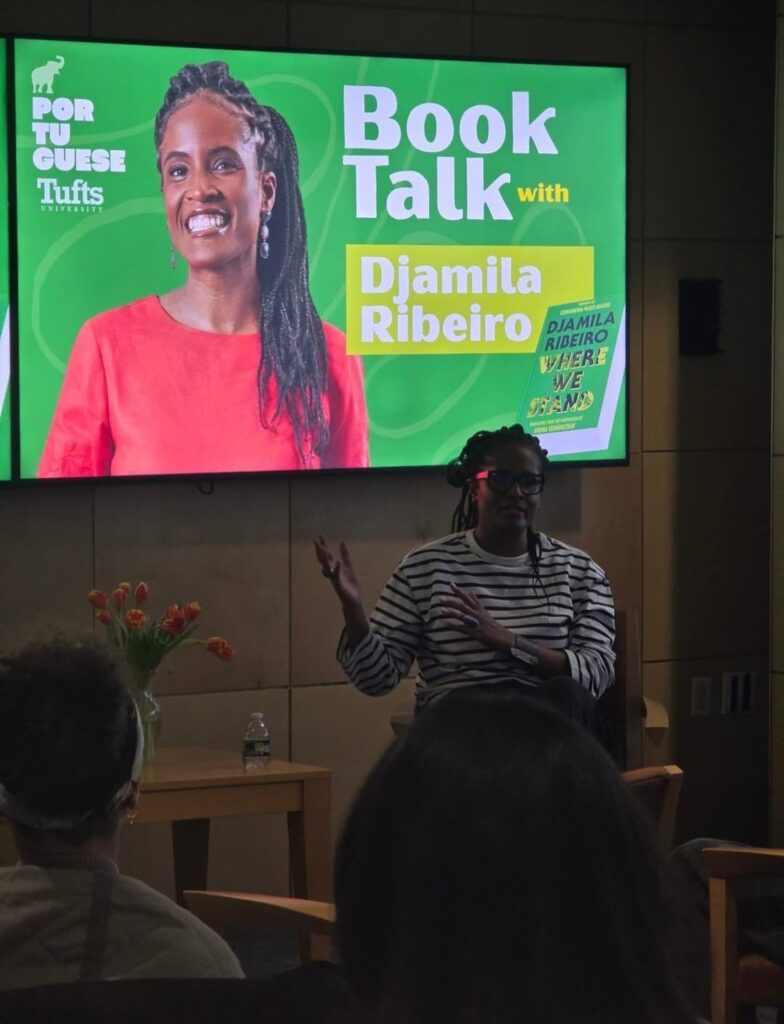
Two more U.S. universities host the launch of ‘Where We Stand’
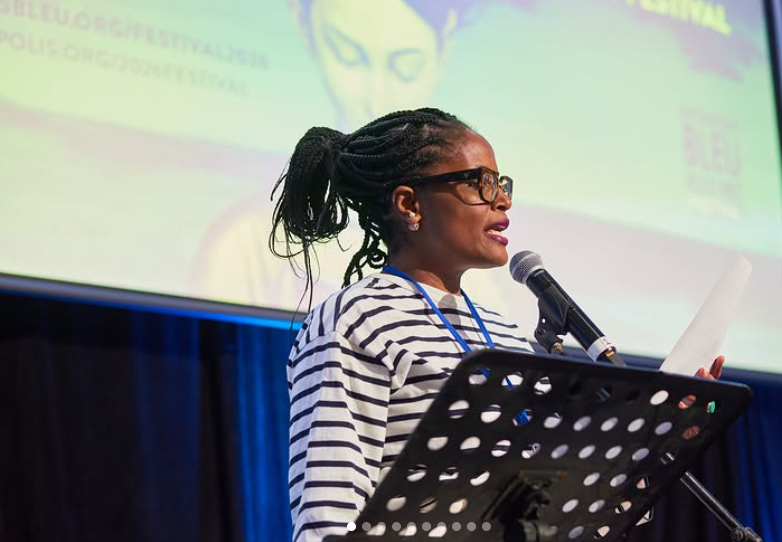
Djamila Ribeiro fills auditorium in debut at Metropolis Bleu Festival in Montreal

Two books by Djamila Ribeiro are among the best Brazilian nonfiction works of the 21st century