


Djamila Ribeiro brings Black Brazilian feminism to the international debate on the Global Majority
November 20, 2026




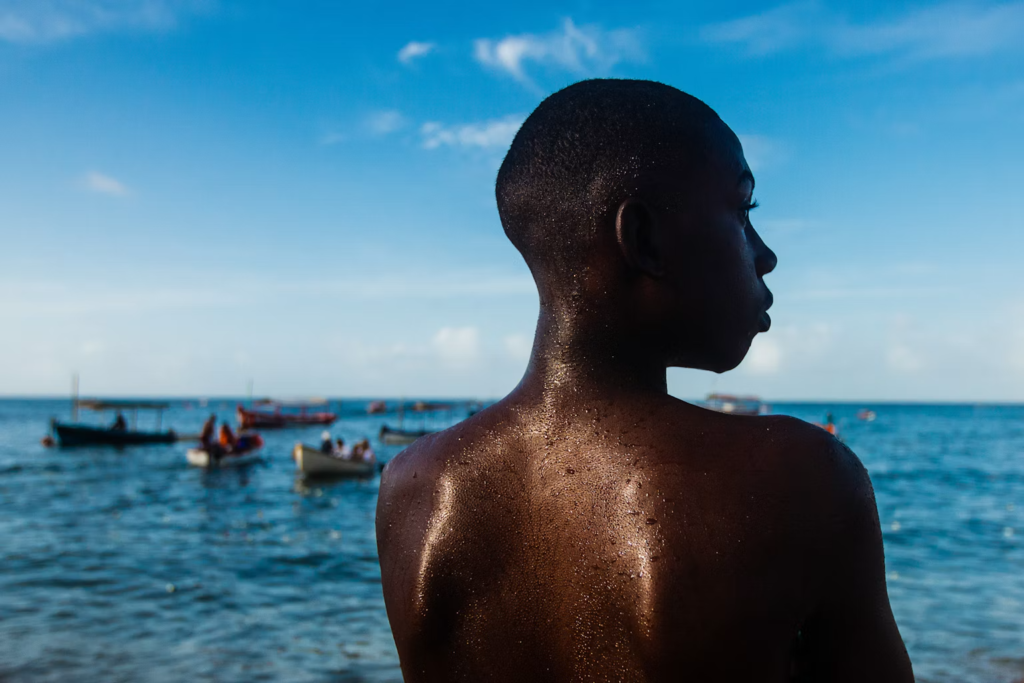
Photo: Amanda Tropicana, Dois de Fevereiro (2017)
In an essay for Ibraaz Publishing, the philosopher draws on Milton Santos to examine how peoples shaped by colonialism can build new forms of solidarity and confront global inequalities
Djamila Ribeiro is taking a question central to her intellectual work to the international stage: how can the knowledge and experiences of historically marginalized populations become concrete possibilities for social transformation? In First Impressions on the Global Majority, published on October 15 by the British cultural platform Ibraaz Publishing, the Brazilian philosopher brings Black feminism into dialogue with the work of geographer Milton Santos to examine the limits of contemporary globalization and the possibilities of building a more equitable world.
The essay builds on questions explored in her books. In Lugar de Fala (Where We Stand), Ribeiro examines the power relations that determine whose voices and knowledge are recognized as legitimate. In Pequeno Manual Antirracista (A Little Antiracist Handbook), she demonstrates how racism structures inequalities and advocates collective responsibility for confronting them. In Cartas para Minha Avó (Letters to My Grandmother), she revisits the memory of the Black women who shaped her upbringing, placing her own life within a history of resistance spanning generations.
These perspectives intersect in the new essay, written for Platform 011, an Ibraaz editorial project dedicated to exploring the political meaning of the term Global Majority. Popularized in the United Kingdom beginning in the 2000s by Rosemary Campbell-Stephens, the concept refers to Black, Asian, and Indigenous peoples and other racialized groups who, though often classified as minorities in majority-white societies, make up most of the world’s population. The term challenges that classification and makes it possible to recognize shared experiences among peoples historically subjected to colonialism and marginalization, taking their histories as a meeting point for knowledge production and the development of new forms of solidarity.
What do these societies have in common? How can experiences of oppression and resistance become opportunities for collective action while respecting historical, cultural, and political differences? Above all, when does the Global Majority cease to describe an existing condition and begin to contribute to the creation of a new reality?
To address these questions, Ribeiro turns to Por uma outra globalização (Toward an Other Globalization), published in 2000 by Brazilian geographer Milton Santos (1926–2001). Revisiting Santos’s distinction between globalization as fable, as perversity, and as a possibility for transformation, the philosopher challenges a development model that concentrates wealth, technology, and decision-making power while presenting its benefits as universal.
Ribeiro’s contribution, however, goes beyond a critique of the global order. The Brazilian intellectual proposes understanding the Global Majority as a political possibility still taking shape, capable of bringing together peoples whose histories of exploitation and resistance are not identical but reveal shared structures of domination.
“The Global Majority is itself an unrealised possibility, gaining force through encounter and communion,” Ribeiro writes in the essay published by Ibraaz.
Ribeiro’s involvement in Platform 011 also extends to presenting the work of Brazilian artists. Her essay features photographs by Amanda Tropicana from Foto-diáspora (Photo-Diaspora, 2025) and Dois de Fevereiro (2017). In a separate publication devoted to the Bahia-born photographer, Ribeiro introduces a project documenting Candomblé matriarchs, highlighting the role of the iyalorixás (Candomblé high priestesses) in preserving memory, passing on ancestral knowledge, and sustaining Afro-Brazilian religious communities.
The Brazilian thinker has also written about Gael Rocha, an artist from the state of Espírito Santo who paints on paper coffee filters. In What the Filter Holds, published on November 3, Ribeiro connects his work to the history of Brazilian coffee cultivation, shaped by enslaved Black labor, and to the relationships between memory, territory, and Afro-Brazilian spirituality. The philosopher recalls meeting Rocha at a book signing in Vitória, where he showed her images of his paintings. The encounter inspired her to introduce his work to the platform’s international readership.
By shifting the discussion from national identities to relationships between different peoples, Ribeiro returns to a concern that has shaped her work since her earliest books: the need to recognize those historically excluded from positions of power as producers of knowledge and political alternatives. The inclusion of Amanda Tropicana’s and Gael Rocha’s work extends this reflection into the visual arts, highlighting other ways of interpreting and sharing historical experiences.
Read the publications on Ibraaz Publishing:
- First Impressions on the Global Majority, de Djamila Ribeiro
- Photo-Diaspora, de Amanda Tropicana e Djamila Ribeiro
- What the Filter Holds, de Gael Rocha e Djamila Ribeiro
Translated by AI
Ver esse post no Instagram
Related articles

Djamila Ribeiro Presents Travessias in Lisbon and Porto on November 29 and December 2
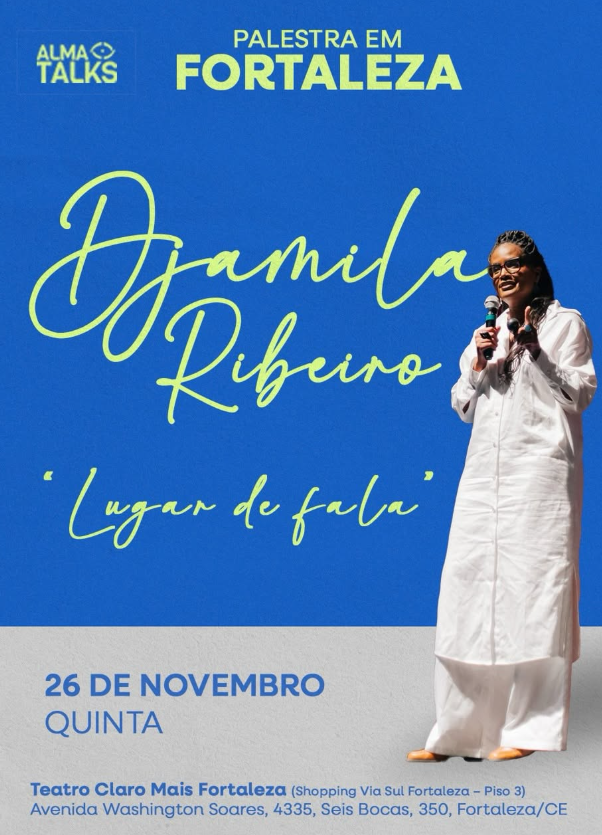
Djamila Ribeiro Presents Lugar de Fala in Fortaleza on November 26

Djamila Ribeiro Brings ‘Lugar de Fala’ to Pará for Black Consciousness Day