


University of Oxford highlights Djamila Ribeiro’s keynote lecture in its main institutional publication
December 23, 2025




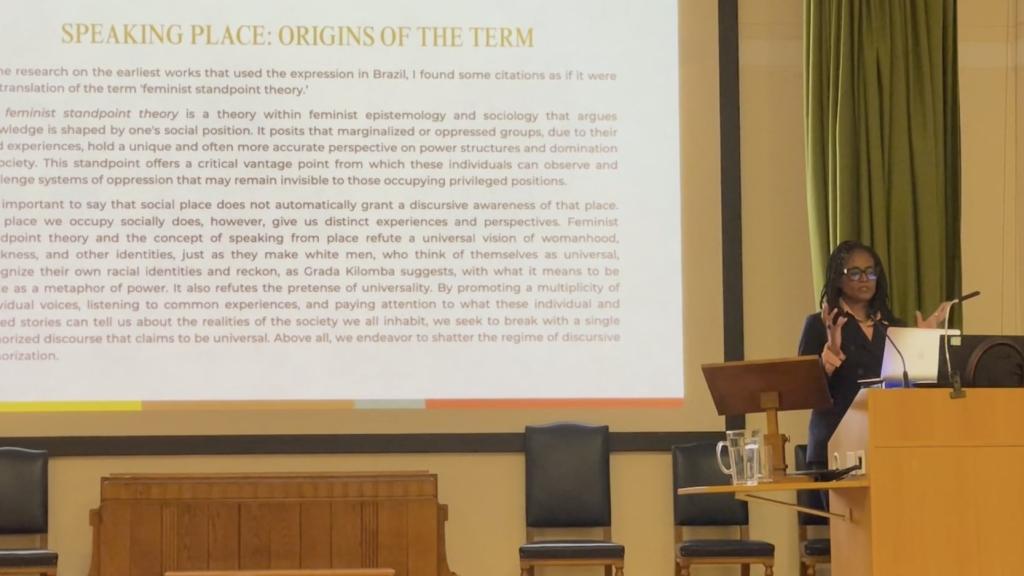
In an article published this week, Oxford acknowledges the impact of Brazilian philosopher Djamila Ribeiro, who delivered the traditional Taylor Lecture in June, based on Where We Stand, the English-language edition of Lugar de Fala.
The University of Oxford has officially included the keynote lecture delivered by Djamila Ribeiro as one of the standout events of the 2025 academic year. The lecture, which took place on 2 June as part of the historic Taylor Lecture series, was featured in the institutional newsletter Oxford Polyglot, published this December, and received praise for its conceptual rigour, political force, and strong audience engagement.
Organised annually since 1889, the Taylor Lecture welcomed, in its 2025 edition, a Black Brazilian philosopher for the first time. The invitation came from the University’s Department of Portuguese, and the lecture was grounded in Where We Stand — the English edition of Lugar de Fala, published by Yale University Press with a foreword by writer Chimamanda Ngozi Adichie.
“I feel the weight and responsibility of occupying this space as a Black Brazilian intellectual,” Djamila wrote at the time on her Instagram profile. In a pointed reflection, she also noted that the Taylor Lecture was established just one year after the abolition of slavery in Brazil — a historical proximity that makes her presence at the event even more symbolic.
The lecture was fully booked, with a waiting list, and took place at Trinity College, one of the oldest colleges at the British institution. The article published by the University of Oxford highlights that the warmth of the audience was evident from the very first moments, when Djamila greeted the room with a “Boa tarde” — immediately met with an enthusiastic response.
“Speaking Place”. This was the familiar-yet-enigmatic phrase encountered by the audience as we took our seats for the highly anticipated 2025 Taylor Lecture. Fortunately for us, however, we were about to be taken on a fascinating journey through the minds and workings of numerous feminist thinkers to discover the significance of this concept, led by none other than award-winning Brazilian philosopher, Djamila Ribeiro.
The article also underscores Djamila’s role as coordinator of the Plural Feminisms initiative, highlighting the remarkable reach of her work and her recent awards: “Djamila Ribeiro is a Brazilian activist, writer, and coordinator of the Plural Feminisms initiative who has authored an array of best-selling, award-winning publications, with a total of more than 1 million copies sold. Most recently, she received the Franco-German Prize for Human Rights and in 2021, her Pequeno Manual Antirracista (2019) won the Humanities category of the Jabuti Prize, Brazil’s most prestigious literary award.”
The newsletter further emphasises the urgency of recognising how the exclusion of certain social groups from spaces such as universities, the media, and institutional politics prevents them from being heard as subjects. The text notes that Djamila “introduced us to a multitude of female thinkers who, despite their prodigious quantity, are rarely cited in Philosophy”.
One of the most emblematic passages states: “What was perhaps most admirable, however, was the way in which Djamila Ribeiro strengthened this vibrant map of thinkers by enriching it with her own experiences as a black, Brazilian woman.” According to the article, this personal perspective was “not only a defining aspect of her lecture, but also provides an important foundation for her writing”, generating immediate identification among the young women academics in attendance.
The piece published on Oxford’s website also reports that, following the lecture, all the questions posed to the philosopher came from women — a fact that, as the bulletin notes, reveals the power of Djamila’s gesture in breaking a long-standing historical silence.
More than a one-off event, Djamila Ribeiro’s lecture has now become part of the University’s institutional memory. In addition to its feature in Oxford Polyglot, the institution officially acquired her work for the collections of Oxford’s libraries — a gesture that Djamila herself celebrated on social media: “I was very happy to see such strong interest from academics.”
Her presence at Oxford therefore not only reflects the international reach of her thought, but also reinforces the need to reassess which voices have been systematically silenced within major institutions of knowledge.
Now officially recorded, Djamila Ribeiro’s keynote lecture becomes part of the intellectual legacy of the Taylor Lecture.
Read the original publication below:
Djamila Ribeiro in Oxford
A thrilling Lecture by one of Brazil’s foremost thinkers
“Speaking Place”. This was the familiar-yet-enigmatic phrase encountered by the audience as we took our seats for the highly anticipated 2025 Taylor Lecture. Fortunately for us, however, we were about to be taken on a fascinating journey through the minds and workings of numerous feminist thinkers to discover the significance of this concept, led by none other than award-winning Brazilian philosopher, Djamila Ribeiro.
Djamila Ribeiro is a Brazilian activist, writer, and coordinator of the Plural Feminisms initiative who has authored an array of best-selling, award-winning publications, with a total of more than 1 million copies sold. Most recently, she received the Franco-German Prize for Human Rights and in 2021, her Pequeno Manual Antirracista (2019) won the Humanities category of the Jabuti Prize, Brazil’s most prestigious literary award. Following its recent publication in English, however, it was her inaugural text Lugar de Fala (2017), translated as Where We Stand (2024), which she shared with her eager Oxford audience.
Having worked at a host of academic institutions, including the University of São Paulo and New York University, Ribeiro is no stranger to a university setting. As she greeted us with a rousing “Boa tarde”, we immediately felt at ease in her presence. Within mere minutes of taking the stage, it was clear that she had established the lecture hall as a palpably transparent environment in which every voice would be validated and heard. It was thus no surprise when, after just a moment’s encouragement from Ribeiro, we showed no hesitancy in returning her greeting with our own enthusiastic reply: “Boa tarde!”.
Her lecture, in which she sought to clarify the disputed meaning of “speaking place” and give voice to the plethora of unheard black female voices in Philosophy, was testament to this visibility and truthfulness. As she led us through the central thesis of her book, Where We Stand, Ribeiro introduced us to a multitude of female thinkers who, despite their prodigious quantity, are rarely cited in Philosophy, cast aside instead by the white, male voices of Western thinking. In a deconstruction of this Eurocentric, heteronormative norm, therefore, Ribeiro invoked the names and works of thinkers such as Grada Kilomba, Lélia Gonzalez, and Luiza Bairros, all of whom have made notable (yet often neglected) contributions to the concept of the “speaking place”. A key part of this philosophy, as Ribeiro pointed out, is Bairros’ feminist standpoint theory, wherein she labels the inability for certain individuals to be justly present in domains such as universities, the media, and institutional politics as a prevailing reason for their inability to be heard or categorised as individual voices.
What was perhaps most admirable, however, was the way in which Djamila Ribeiro strengthened this vibrant map of thinkers by enriching it with her own experiences as a black, Brazilian woman. This personal perspective was not only a defining aspect of her lecture, but also provides an important foundation for her writing, and it is likely due to such authenticity that it is valued so highly. In a roomful of aspiring academics, of which a large proportion were women ourselves, this kind of representation was thus deeply affecting for, although the contribution made by white male philosophers cannot be disputed (as Ribeiro herself pointed out), these voices represent only a fraction of the population.
Fittingly, therefore, it was the following quotation by Jota Mombaça, taken from Ribeiro’s Where We Stand, with which Phillip Rothwell introduced the lecture: “The political gesture of inviting a cis Euro-white man to be quiet and think before speaking introduces, in reality, a rupture in the regime of authorization already in force.” And this was precisely what Ribeiro succeeded in doing, as was proven by the series of thought-provoking questions by which the lecture was followed – posed entirely by women. This can only be described as testament to Djamila Ribeiro’s strength as an empowered and empowering woman to inspire other women around her to follow suit. We truly could not have asked for a more memorable start to Trinity sixth week, and there is little doubt that, as a result of the ninety minutes we spent together with Ribeiro, copies of her book will be flying off Blackwell’s shelves at an even faster rate than they already were.
Many thanks go not only to Djamila Ribeiro, but also to Dr Gui Perdigão, Prof Phillip Rothwell, the Camões Instituto da Cooperação e da Língua, and all those involved in making the event possible.
Related articles

“The Danger is Unpunished Machismo”: Djamila Ribeiro Dismantles the Inverted Logic of Gender Violence

You can now join Djamila Ribeiro’s exclusive WhatsApp community
“Racism is a white thing. It is the burden of white people,” says Nadia Yala Kisukidi