


Djamila Ribeiro’s Pará Tour Draws More Than 3,500 People
November 22, 2026




Dedicated to Zélia Amador de Deus, the tour took the philosopher to three cities in northern Brazil, set attendance records and included antiracist education initiatives
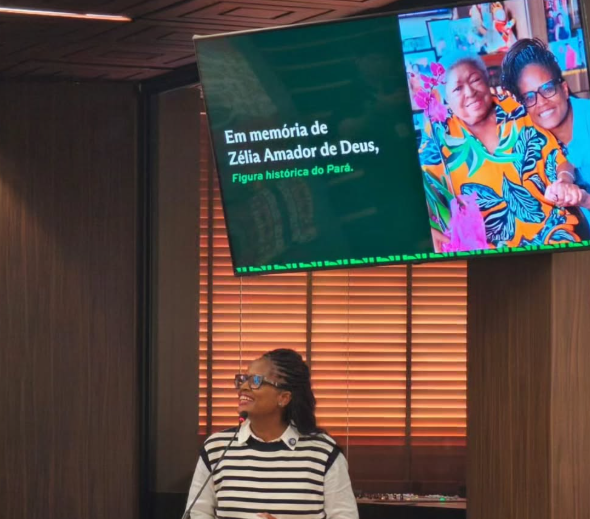
Djamila Ribeiro’s Pará tour drew more than 3,500 people to events in Belém, Santarém and Canaã dos Carajás from Nov. 17 to 20. Along the way, Ribeiro presented the new edition of Lugar de Fala (Place of Speech) and honored the memory of Professor Zélia Amador de Deus, a leading figure in the Black movement in Brazil’s Amazon region, who died in September 2026.
“Pará, that was something else!” Ribeiro wrote on social media. “It was a joy to present the new edition of Lugar de Fala and talk with people across Pará in so many different settings.”
The tour set attendance records at two events organized by the Escola Judicial do Poder Judiciário do Pará (Pará Judiciary School, EJPA): 1,000 people in Belém on Nov. 17 and more than 700 in Santarém on Nov. 18, in the auditorium of the Universidade Federal do Oeste do Pará (Federal University of Western Pará, Ufopa).
“Seven hundred, because there wasn’t room for the more than 1,000 people who registered,” Ribeiro said.
The tour ended Nov. 20 at the seventh Festival Literário e Artístico de Canaã dos Carajás (Canaã dos Carajás Literary and Arts Festival, Flacc). The date is Brazil’s National Day of Zumbi and Black Consciousness, which honors Zumbi dos Palmares, the 17th-century leader of Palmares, the largest quilombo — a settlement founded by people who escaped slavery — in colonial Brazil. According to the municipal government, more than 2,000 people attended the lecture launching Lugar de Fala.
During the event, Ribeiro examined the historical roots of racial inequality in Brazil, explaining how 19th-century legislation helped shut Black Brazilians out of education and land ownership. In Pequeno Manual Antirracista (Small Antiracist Handbook), she discusses two examples of this process: the 1824 Constitution, which did not guarantee enslaved people the right to education, and the 1850 Land Law, which made purchase the only legal way to acquire land, putting land ownership out of reach for Black Brazilians. The effects of these measures outlasted the abolition of slavery in 1888 and help explain the need for affirmative action to address structural injustices that run through Brazilian history.
“The debate over quotas isn’t about ability; it’s about opportunity,” Ribeiro said during the event in Canaã dos Carajás.
Ribeiro’s visit also included engagements with public institutions. On Nov. 19, she took part in a special session of the Assembleia Legislativa do Pará (Pará State Legislative Assembly, Alepa) that marked the conclusion of Raízes da Igualdade: Formação em Letramento Racial (Roots of Equality: Racial Literacy Training).
Developed by Alepa’s Human Rights Committee in partnership with the Instituto de Ciências Jurídicas da Universidade Federal do Pará (Institute of Legal Sciences at the Federal University of Pará, UFPA), the program trained 10 cohorts between March and November 2026. Topics included racial and ethnic relations, human rights and the fight against racism. The cohorts brought together public servants and members of civil society.
Attendees included state legislators Lívia Duarte and Carlos Bordalo, the Alepa president; UFPA faculty members; and researcher Ana Rodrigues of the Pontifícia Universidade Católica de São Paulo (Pontifical Catholic University of São Paulo, PUC-SP), who spoke about algorithmic racism and how digital technologies reproduce racial inequality.
The ceremony also included the presentation of certificates to participants and a moving tribute to Amador de Deus.
Ribeiro also gave a lecture to employees of Banco da Amazônia (Bank of the Amazon) as part of Dia Zélia Amador de Deus (Zélia Amador de Deus Day), a program the bank held in her honor during its Black Consciousness Day observances. She also took part in an online event with Afya, a medical education group.
Honoring the Life and Legacy of Zélia Amador de Deus
Zélia Amador de Deus, a professor emerita at UFPA, died Sept. 8, 2026, at age 74. An actress, researcher and co-founder of the Centro de Estudos e Defesa do Negro do Pará (Center for the Study and Defense of Black People in Pará, Cedenpa), she devoted her career to advocating for affirmative action, fighting racism and promoting recognition of Black communities in the Amazon.
Founded in Belém in 1980, Cedenpa is a Black movement organization that defends the rights of Black Brazilians, works for the recognition of quilombola territories — lands held by descendants of quilombo communities — and promotes racial equality. Amador de Deus helped found the organization as social movements were reorganizing under Brazil’s military dictatorship (1964–85), and she went on to become one of the region’s leading organizers in the fight against racism.
Her work also reached the university, where she served as vice rector — the equivalent of a vice president at a U.S. university — from 1993 to 1997 and took part in initiatives to expand access to higher education for Black and quilombola students.
The tribute also recalled an intellectual connection between the two thinkers. In Pequeno Manual Antirracista, published in 2019, Ribeiro had already named Amador de Deus among the Black women intellectuals working outside Brazil’s major cities whose work deserves to be known and valued. The book presents their scholarship as essential to countering the historical erasure of knowledge produced by Black people.
The tour also brought Ribeiro together with Amador de Deus’ family and members of Cedenpa, who welcomed her in Belém.
“It was so special to meet Zélia’s beloved family and to receive gifts and so much love from them and from my comrades at Cedenpa,” Ribeiro said.
Dedicating the tour to Amador de Deus carried special meaning, as its final stop fell on Black Consciousness Day.
“This November 20, I’m thinking about what it means to honor the memory of a woman like Professor Zélia, who left us this year with an immeasurable legacy,” Ribeiro wrote.
Another meaningful encounter was with adolescents in court-ordered juvenile justice programs in Icoaraci, a district of Belém. Teacher Lindomar presented Ribeiro with a painting the teens had made during an activity inspired by historical figures.
In the activity, the young people picked figures from the past to represent people of today. To portray Ribeiro, they chose Queen Nzinga (known in Brazil as Rainha Ginga), the 17th-century ruler of Ndongo and Matamba, in present-day Angola, and a central figure in African resistance to Portuguese colonization.
Ribeiro also highlighted her conversations with local university students. In her post, she wrote: “It’s very moving to know how much my work remains a touchstone for young people in college who have been studying my books since middle school.”
Enthusiastic crowds and recognition from several generations of readers closed out the Pará tour. In her last post from the trip, Ribeiro again paid tribute to the professor to whom the tour was dedicated:
“My deepest gratitude to the people of Pará, who always welcome me with so much love! Thank you, Pará! Thank you, Zélia!”
Translated by AI
Ver esse post no Instagram
Ver esse post no Instagram
Ver esse post no Instagram
Related articles

On ‘Provoca,’ Djamila Ribeiro Expands on Place of Speech and Reflects on Racism, Ancestry and Self-Care
Djamila Ribeiro brings Black Brazilian feminism to the international debate on the Global Majority

Djamila Ribeiro Presents Travessias in Lisbon and Porto on November 29 and December 2