


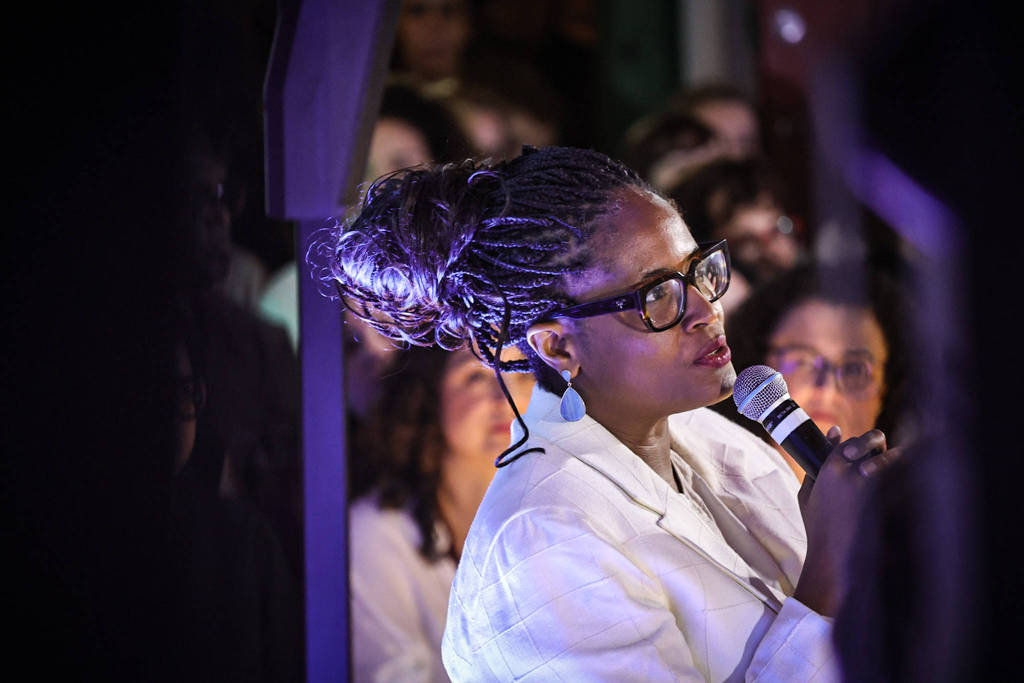
At Flip 2026, Djamila Ribeiro Pushes Back on Distortions of Place of Speech and Announces Book on the Red Pill Movement
July 25, 2026




Ribeiro said the idea for her new book grew out of conversations with her 21-year-old daughter
Djamila Ribeiro drew a capacity crowd to CasaFolha on Friday, July 24, during the Festa Literária Internacional de Paraty (Paraty International Literary Festival), known as Flip 2026. Greeted with enthusiastic applause, Ribeiro presented the new edition of Lugar de Fala (Place of Speech), published in June by Rosa dos Tempos, an imprint of Grupo Record. Revised and expanded, the book argues that there is no neutral or universal position in discourse: whenever we speak, we interpret the world from a social position shaped by race, gender, class and sexuality.
“People who distort the concept claim that lugar de fala means preventing others from speaking. But the exclusion is already in place — why, until 2014, were 90% of philosophy books written by white people?” she said.
The purpose, she explained, is to create space for other voices and challenge the idea that privilege is natural.
“When you point it out and say, ‘No, but you are a white man; you have a social position,’ they become uncomfortable.”
Ribeiro also took apart the claim that examining race and gender is what divides Brazilian society, arguing that this criticism gets the logic backwards: inequality existed long before it was named.
“What power do we have to divide society? Nearly four centuries of slavery divided society. Patriarchy divides society,” she said.
Brazil’s social structure, she added, already distributes power and opportunities unequally.
“Statistics place Black women at the bottom of the social hierarchy, while white men remain at the top. What we are doing is naming a division that is already there — one that a long tradition has refused to acknowledge,” she said.
Naming that reality, she argued, is a necessary condition for changing it.
“Refusing to name it means denying that the problem exists. How can we imagine emancipatory solutions for something that has no name? If I do not acknowledge that society is racist — as the Brazilian state refused to do for a very long time — how can I create public policies for the Black population?” she asked.
Ribeiro also criticized the selective use of the label “identitarian,” noting that it is applied almost exclusively to historically marginalized groups — as though whiteness and masculinity were not themselves socially constructed identities.
“It’s always the others who are identitarian,” she said. “As though whiteness were not an identity. As though masculinity were not an identity. The problem is that this subject sees himself as universal. He never names his own position.”
Returning to the core of the concept, Ribeiro stressed that her analysis does not treat identities as fixed categories; it focuses on the structural relationships that determine how power mobilizes them.
“That is another mistaken interpretation, because this is a structural debate. I am not interested in identity in and of itself. I am interested in how power mobilizes identities, oppressing some to the benefit of others.”
New Book
Ribeiro also revealed that she is working on a new book about the red pill movement, an online phenomenon that channels frustration and the search for belonging into misogynistic narratives about relationships, power and gender roles. The idea came from her daughter, who is 21.
“She would tell me, ‘Mom, you need to talk about this.’ I realized it was important to examine the issue because we can see how lost parents, guardians and educators are in this world. We can also see how many people — especially so-called coaches — are profiting from these boys’ resentment and search for identity.”
The subject has already been addressed in an online course offered to educators, students, schools, universities, and public and private institutions. The program provided tools for understanding the manosphere and confronting the rise of masculinist ideology among young people, particularly in digital spaces.
[Watch: https://www.youtube.com/watch?v=4Is2UlNQD6Q]
Photo: Rafaela Araújo/Folhapress
Ver essa foto no Instagram
Ver essa foto no Instagram
Related articles
Djamila Ribeiro Launches New CasaFolha Course on Lugar de Fala
An Unforgettable Evening: Djamila Ribeiro Honored at Gathering with São Paulo Public School Students

Djamila Ribeiro at FLIP 2026: Three Events in Paraty