


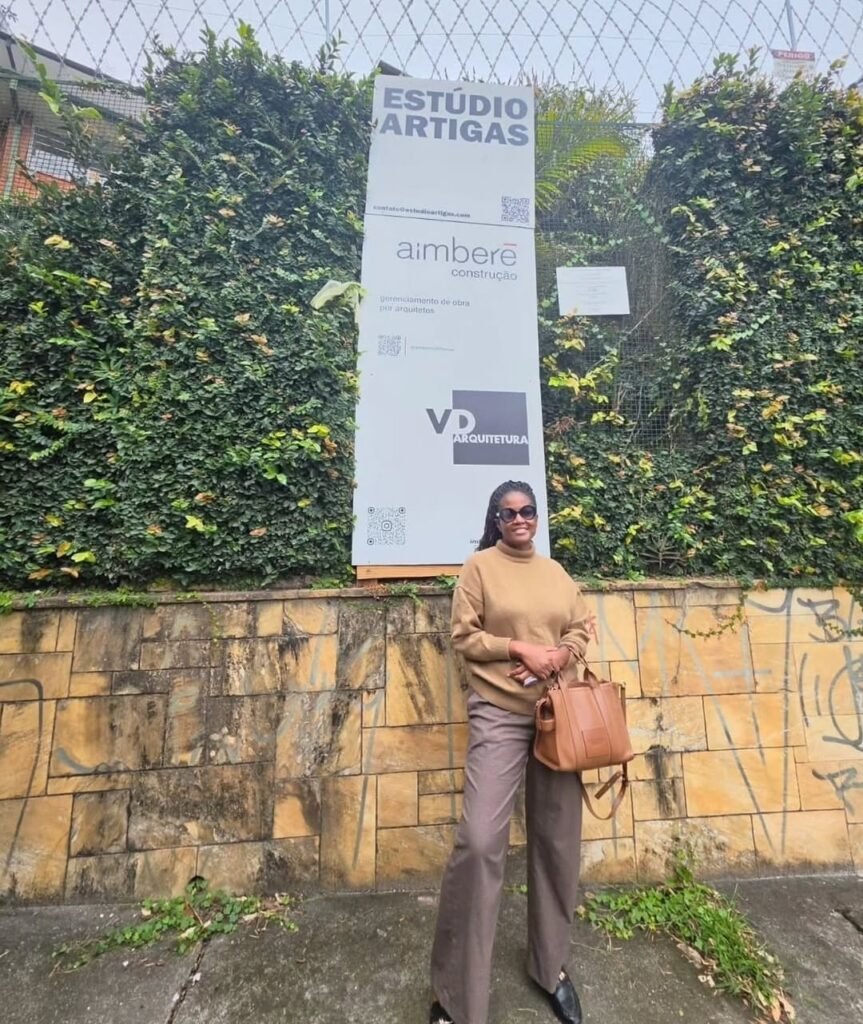
Djamila Ribeiro shares progress on the restoration of Casa Rio Branco Paranhos, a home for artist residencies
September 10, 2026






Designed by Vilanova Artigas in 1943, the house is being restored and will become Casa Paranhos Ribeiro, a residency space for young artists and architects
Djamila Ribeiro took to social media to share progress on the restoration of Casa Rio Branco Paranhos, a house in São Paulo’s Pacaembu neighborhood designed by architect Vilanova Artigas in 1943. Purchased by the writer in 2021, the property will take on a new role as Casa Paranhos Ribeiro, which will host residencies for young artists and architects.
“Although the house had been a protected landmark since 2015, both because it was designed by Artigas and because of its own history, it was nearly abandoned at the time,” the Brazilian philosopher wrote.
The house is considered representative of Artigas’ residential work from the early years of his career and reflects a period of intense experimentation.
“I bought it with a commitment to preserving the history of the house while also making it my home. I decided to move in right away, in 2021, and this year we had the opportunity to bring it back to life with the long-awaited renovation,” Djamila said.
The restoration brings together two generations with direct ties to Vilanova Artigas. The project is led by Marco Artigas, the architect’s grandson; Vera Domschke, a former student of Artigas; and her daughter, Carol Sacconi.
“The grandson and the student will tell the story, preserving the past while designing the future,” Djamila added.
The restoration plan drew on photographic and topographic surveys, as well as research into historical documents. The original drawings of Casa Rio Branco Paranhos, held in the archives of the Faculdade de Arquitetura e Urbanismo da Universidade de São Paulo (School of Architecture and Urbanism at the University of São Paulo), were digitized to guide the work.
The plan calls for removing later additions that, over the decades, obscured the original design.
Planned work includes restoring the roof, the living room pergola, and the window frames and openings, as well as rebuilding the entrance staircase.
New structures needed for contemporary use will be built into the terrain so that the 1943 house remains the focal point of the property.
The changes, however, go beyond the physical restoration of the building. Djamila will host artist residencies at the future Casa Paranhos Ribeiro, giving young artists and architects the chance to live and work in a building by one of the leading figures of Brazilian modern architecture.
The initiative brings together heritage preservation, training and knowledge sharing.
Djamila said additional supporters of the project will be announced soon.
“Casa Rio Branco Paranhos is preparing to become Casa Paranhos Ribeiro. The story will continue to be told,” the philosopher concluded.
A house shaped by architecture and politics
Built in Pacaembu, Casa Rio Branco Paranhos dates from the early years of Vilanova Artigas’ independent practice. The state landmark designation cites the residence as an example of his work from 1938 to 1944, noting the influence of Frank Lloyd Wright on how it addresses a steeply sloped site: articulated volumes, cantilevers and close integration with the landscape.
Wright’s influence can also be seen in the flow between interior spaces, the relationship between the building and the site, and the way Artigas explored the possibilities of his materials. Studies of his work identify Casa Rio Branco Paranhos as one of the most significant buildings from this period of his career.
The residence also reflects the experimental nature of the architect’s work. In an account reproduced in the restoration report, Artigas recalled doing the structural calculations for one of the terraces himself and working out how to combine large cantilevers with traditional timber roofs. The episode reveals a young architect investigating structure, materials and space all at once.
The history of the house, however, extends beyond architecture. Artigas designed it for Rio Branco Paranhos, a labor lawyer and fellow member of the Brazilian Communist Party. Paranhos was elected to Brazil’s Chamber of Deputies but was prevented from taking office by the military regime established in 1964. Decades later, in 2015, the residence bearing his name was designated a state landmark by São Paulo’s Conselho de Defesa do Patrimônio Histórico, Arqueológico, Artístico e Turístico (Council for the Defense of Historical, Archaeological, Artistic and Tourist Heritage).
Related articles


Djamila Ribeiro Discusses Place of Speech and Antiracist Education at a São Paulo Private School

Racismo Recreativo (Recreational Racism), by Adilson Moreira, now available for pre-order


Since June, Nine Cities Have Hosted Launches for the New Edition of Lugar de Fala