


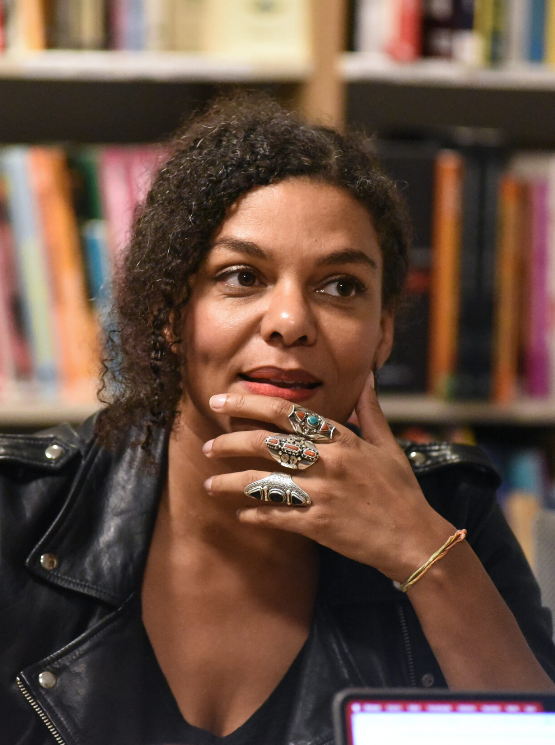
“Racism is a white thing. It is the burden of white people,” says Nadia Yala Kisukidi
December 3, 2025






By Mariana Rosetti, in Elle
Photo: Rodrigo Trevisan Dias
In a conversation at the Feminismos Plurais Space (Espaço Feminismos Plurais), the French philosopher talks about dissociation, the power of wonder in literature, and why fighting racism is the responsibility of those who created it.
While watching an Instagram live hosted by professor, philosopher, writer, and Black feminist activist Djamila Ribeiro, the French philosopher and writer Nadia Yala Kisukidi had her attention caught by the comment of a Black woman: “I’m so tired of racism and of all the weight my body has to carry that I want to get rid of it. I just want to live like a spirit,” she said.
Yala knew that feeling was not a metaphor but an expression of the desire for dissociation — not coincidentally, that is the very word in the title of her debut novel. “What she said is exactly the experience of dissociation: when you can no longer endure what your body has to carry socially,” the author explains. The episode took place in 2022.
Her identification with the account of that unknown woman was not merely intellectual — it stemmed from her own life story. Born in Brussels in 1978 to a Congolese father and a French-Italian mother, Yala is an associate professor of philosophy at the University of Paris 8 and a specialist in French and African philosophy.
In an interview with ELLE during her time in Brazil, she spoke about her own attempts at dissociation, the power of literature, and why racism is white people’s problem.
Dissociation as survival
Launched in Brazil in 2024 by the publishing house Bazar do Tempo, La Dissociation (Dissociation) tells the story of an orphaned girl who lives with her grandmother on the outskirts of the industrial city of Villeneuve d’Ascq, in northern France. The girl has an unusual ability: she can separate her mind from her body. Before writing the book, Yala tried to do the same as her character: “If I chose to become a philosopher, it was to free myself from my body,” she confesses.
Her choice was rooted in philosophy’s promise of living through reason, free from prejudice and bias. “I was really upset with this world, dissatisfied as a young person, so I chose philosophy to rid myself of the body. But of course, it’s impossible to get rid of it.”
The author invokes Frantz Fanon’s Black Skin, White Masks to explain why the experience of inhabiting a body can become unbearable, especially when shaped by structures such as racism, sexism, or colonization: “Through racism, the experience you have is that your body is not your property. You are not its subject because it belongs to someone else. It is only race.” Yala outlines two possible paths in such a scenario: the first is to leave oneself; the second is to reclaim one’s physical existence.
In literature, she turns to the first option: “So you tell yourself: ‘This world is not mine. So I will leave this body on this plane and live my whole life as a spirit,’” she says, referring to the protagonist’s feeling. It is a ghost story, about people who dream of living in a world without light — in the dark, there is no race or skin color.
Racism is white
The French philosopher reiterates what Black Brazilian intellectual and activist Lélia Gonzalez argued: “Racism is not my problem — it is yours,” she said, addressing white people. “It’s complicated for me to talk about racism because it reminds me of all the humiliating moments I had to experience as a child. And I cannot accept that. I also remember all the moments when I gave up, and I cannot accept that either,” Yala says.
To her, Black women have been forced to defend themselves against something they did not create: “Racism is a white thing. It is the burden of white people.” Therefore, she adds, “Everything I try to do is avoid being swallowed by this racial vertigo. We know the lyrics, we know the script, we know the music. And I’m tired of singing the same song.”
While living in the United States during the recent presidential campaign, Yala came to understand something important: “Some white people genuinely understood what racism means. They have the privilege and the obligation to fight for others. It’s about refusing what is being fantasized as your race.”
The struggle against racism is not about acting as allies of the poor or offering opportunities: “It’s about breaking the system, and that must be done by the people who benefit from it. Otherwise, it’s just words or charity.”
Multiple languages, hybrid identities
Yala’s choice of wonder and hybrid narrative forms is not only aesthetic — it is political and autobiographical. “I am not only African, I am not only Congolese, I am also European and French,” she states.
This multiplicity shapes her writing, which brings together African oral traditions and marginalized forms of European literature. For Yala, there are two Europes: the colonial one, “which we hate, the one that cannot be saved,” and another that was itself persecuted. She refers to heresies, to people punished by the Catholic Church, to the many ways of knowing and believing that were systematically erased. “Europe is also a complex continent. When I look at it, I also see strong traditions that were erased — less rational, more magical traditions,” she explains.
Her novel was well received in France, despite some initial estrangement. Naturalism and realism dominate French literary expression, but Yala needed wonder, magic, and the fantastical to talk about racism, because “I don’t understand how you can describe racism rationally — it is not rational.”
She illustrates with a personal experience: at age 12, while eating a banana, she was subjected to a racist insult. “There is something defective in the other person’s brain. I cannot understand how someone can see me as a monkey. That is why I cannot use reason, realism, or naturalism to speak about this mess of racism. I need wonder.”
Yala says the world shaped by race is a kind of magical nightmare. “I know exactly what it means to live in a world that is not shaped by racism. I know exactly. It is not a utopia. I know because I am not racist. And I never will be. So I don’t have to invent another word,” she emphasizes.
France, Africa, and Brazil
The interview took place in the library named after Toni Morrison — the editor, writer, and the first and only Black woman to receive the Nobel Prize in Literature — at the Feminismos Plurais Space, an institute led by Djamila Ribeiro that provides intellectual and professional training for Black women, as well as psychological, legal, and dental support.
That afternoon, Nadia Yala Kisukidi was preparing for a conversation with readers from the Movimento Autoral (Authorial Movement) project, created to spotlight works written by women authors. The project connects writers and readers through a book club and in-person meetings like the one held that evening. Coordinated by professor and writer Maria Carolina Casati — who also moderated the conversation with Yala — and supported by the French consulate since the second half of this year, the book club selected La Dissociation as its book of the month.
Although it was Yala’s first time at the space, she and Djamila have known each other for years: they co-wrote Dialogue Transatlantique (Transatlantic Dialogues), published in France by Editions Anacaona in 2020. Djamila joined the conversation remotely from Massachusetts, where she is temporarily based as a visiting professor at MIT.
The event took place one day before the March of Black Women ( Marcha das Mulheres Negras) in Brasília, held ten years after its first edition. This year, thousands of women took to the streets of Brazil’s capital to demand historical reparation and bem viver (Living Well) — a concept that goes beyond access to basic rights and encompasses a dignified life, free from violence and in respect to ancestry.
Held on the International Day for the Elimination of Violence Against Women, November 25, the march brought together supporters from all regions of Brazil and abroad, organized in collectives and social movements that, like the space where Yala spoke that evening, build networks of support and resistance to confront racism.
In another non-coincidence, at the end of the talk, a Black woman in the audience asked to speak and admitted that the book had moved her deeply because, in several situations, she had to create one, two, even three characters to get through racist episodes. It was her attempt at dissociation.
Whether in a conversation in Paris or São Paulo, at the march in Brasília, or in Africa, the exchange of experiences and the dialogue on gender and race reveal deep points of convergence. After listening to the testimony, Yala — who seems to struggle to find words despite having so much to say — responds: “I’m very moved. Thank you.”
Translated with the assistance of AI
Related articles

Black Consciousness: Where Toni Morrison Meets Carolina Maria de Jesus

Djamila Ribeiro Teaches Her First Class at MIT


Djamila Ribeiro Celebrates Consolidated Status as Key Reference for Brazil’s National Exam (Enem) Essays