


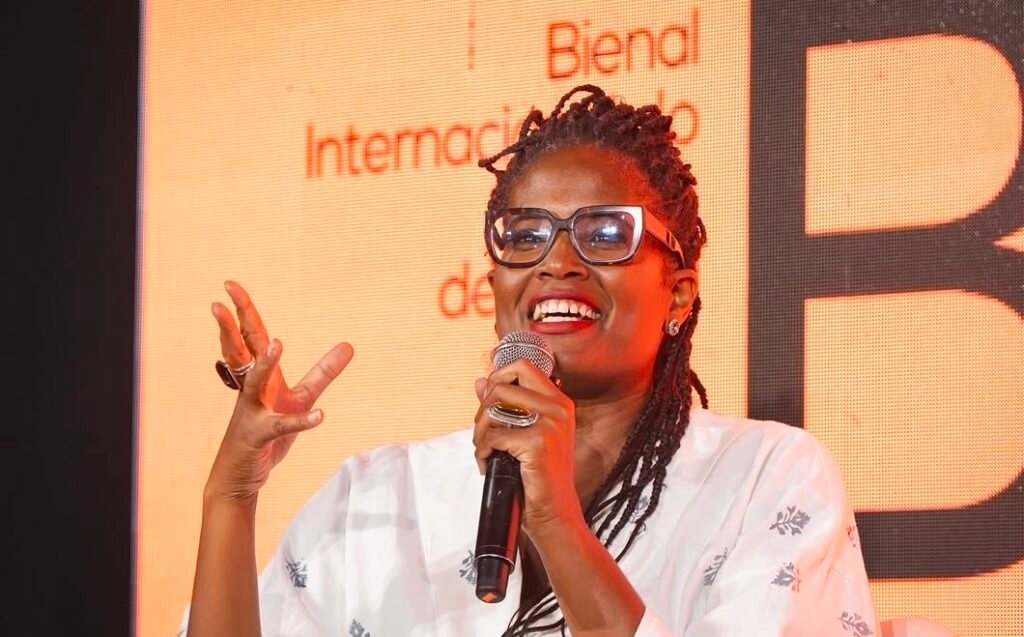
Brasília Book Biennial: Djamila Ribeiro turns the launch of the new edition of Lugar de Fala into a master class on racial literacy and publishing challenges
August 23, 2026




The Brazilian philosopher argued that anti-racist education is the responsibility of every educator, shared behind-the-scenes stories from her years leading the Feminismos Plurais collection, now with Editora Record, and recounted how Chimamanda Ngozi Adichie came to write the foreword
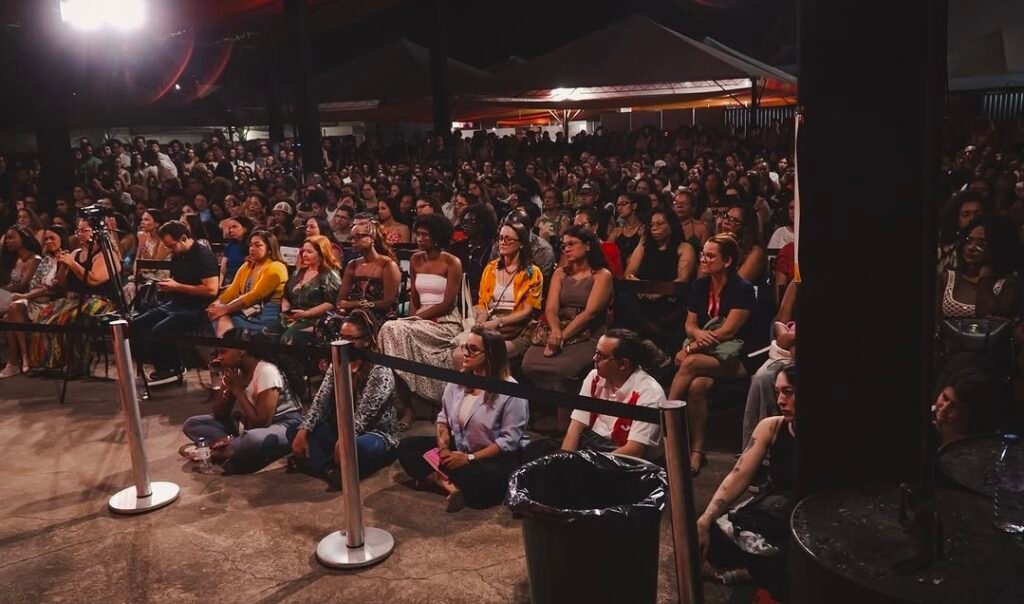
Before an audience that packed the outdoor area of the Museu Nacional da República (National Museum of the Republic) during the 6th Bienal Internacional do Livro de Brasília (Brasília International Book Biennial), Djamila Ribeiro presented the expanded and revised edition of Lugar de Fala (Place of Speech), published in June by Rosa dos Tempos, an imprint of Grupo Record. Nine years after the first edition was released, the new edition has been on tour across Brazil, with launch events already held in São Paulo, Santos, Belo Horizonte, Paraty, and Rio de Janeiro.
The new volume is significantly longer than the original. The opening section has been retained with revisions and updates, while an entirely new second section has been added. The expansion grew out of the need to examine how the concept has circulated over those nine years—a period in which it gained prominence but was also subjected to oversimplification, dilution, and misinterpretation.
In Brazil’s capital, the conversation with the audience became a master class. The first question from the evening’s moderator, Ana Helena Rossi, a professor in the Department of Foreign Languages and Translation at the Universidade de Brasília (University of Brasília, UnB), opened the door for the author to discuss the importance of racial literacy in Brazil.
-
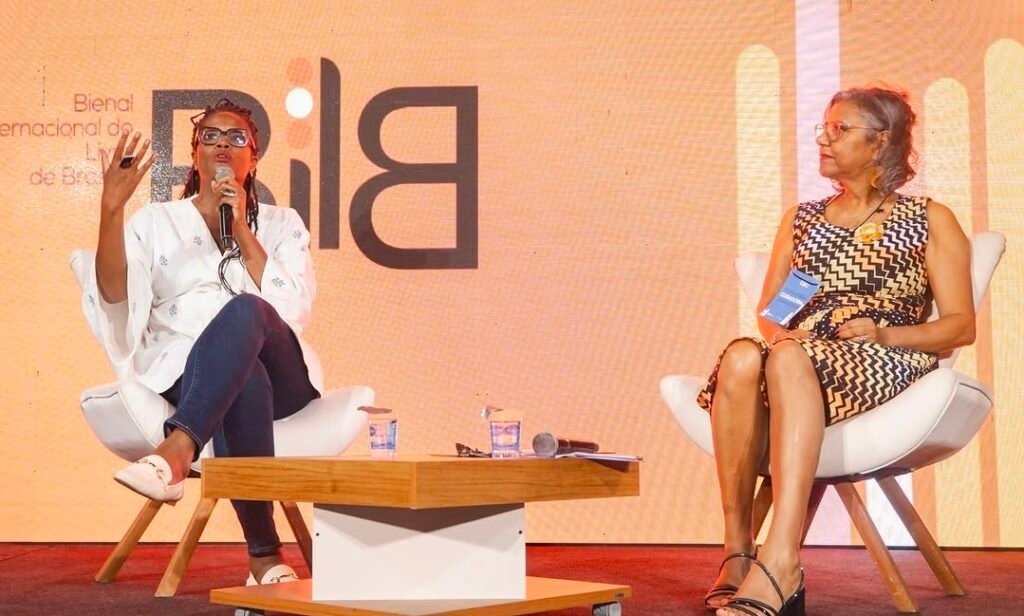
- Djamila e Ana Helena Rossi
Speaking about anti-racist education, Ribeiro returned to one of the contradictions that has shaped Brazilian society: racism was built alongside the denial of its very existence. The last country in the Americas to abolish slavery, Brazil built the myth of racial democracy on that history.
“That made it much harder for us to understand how racism is structured in our country. So it’s very important that we study race, not only from the perspective of oppression, which was denied for a very long time, but also by bringing reading lists and intellectual work by Black people into our curricula. And those works don’t necessarily have to deal specifically with race. A book by a Black author doesn’t have to be about race. We have Black authors working in many different fields—biology, mathematics; I have a daughter studying math now—and so many others. That also helps break down this tendency to put us into boxes, as though we could only speak about certain subjects,” she said.
Djamila stressed the importance of Law 10,639, enacted in 2003, which made the teaching of African and Afro-Brazilian history and culture mandatory in schools, while warning that constant vigilance is necessary.
“Unfortunately, in our country, policies tend to be tied to a particular administration rather than institutionalized by the state. So sometimes we move forward under one administration and backward under the next. And that leaves us with the same difficulty establishing deeper, lasting policies.”
Implementing the law, she emphasized, cannot be treated as the responsibility of Black teachers alone or confined to subjects traditionally associated with racial issues. Responding to a question from the audience about the role of white educators, she was direct:
“Everyone has a place of speech. It’s very important for white teachers to understand that if Law 10,639 exists, then every educator is responsible for implementing it. Sometimes you hear this argument: ‘Oh, but I’m white,’ followed by another distortion of the concept of place of speech: ‘That’s not my place of speech.’ You’re going to speak, but from a different position. If only Black teachers are responsible for anti-racist education, how is that supposed to work when we’re a minority? This is the responsibility of every educator,” she explained.
The author added that just as white writers have been part of the school and academic education of generations of students, the study of race relations and Black intellectual production must become part of the knowledge base of educators and professionals in every field.
“Just as we had to study white European authors, white people also need to study race so they can bring that knowledge into the classroom and build an education that truly understands this multiplicity of voices and intellectual traditions,” she said.
That kind of education, she argued, makes it possible to understand how racism shapes decisions that may initially seem far removed from racial issues.
“It doesn’t matter what subject you teach. Sometimes people tell me, ‘I’m in chemical engineering. Why do I need to know about this?’ Because you live in a society in which racism structures social relations. Imagine you’re an engineer developing a project for a company in an Indigenous community. If you don’t know Brazilian history, you may not be able to understand the impact that work will have on that community. Or think about artificial intelligence data centers, which consume enormous amounts of water and have affected many communities’ access to that resource. Of course you need to understand these issues, regardless of the field you work in.”
Anti-racist education, then, cannot be reduced to interpersonal relationships or to the idea of teaching respect for differences. It must cut across disciplines.
“People still reduce anti-racist education to something like ‘teaching kids to be nice to their Black classmates.’ That’s not what we’re talking about. It’s about understanding your role and recognizing that this discussion cuts across every field. The problem is that race is usually treated as a specialized issue. For example, if most people experiencing homelessness in Brazil are Black, then talking about housing also means talking about race. That can’t be confined to the Ministério da Igualdade Racial (Ministry of Racial Equality), especially when it has a limited budget. Likewise, if many women can’t leave abusive relationships because they have nowhere else to go, then talking about housing also means talking about women’s issues,” she emphasized.
For Djamila, the role of white educators is precisely to broaden that knowledge base instead of treating race and gender as isolated or peripheral issues.
“Part of a white educator’s responsibility is becoming racially literate and understanding that reading half a dozen Black authors isn’t enough. We need a broader understanding of what anti-racist education actually means. We need to understand, for example, the impact of hydroelectric dams on Indigenous communities. That’s part of the racial discussion too. Reducing this debate to something merely ‘identity-based’ means failing to understand that we’re talking about structures,” she said.
The challenges of publishing
The first title in the Feminismos Plurais (Plural Feminisms) collection, Lugar de Fala was originally published in 2017 by Letramento and moved to Jandaíra’s catalog in 2019. The collection comprises 14 titles written exclusively by Black authors.
The initiative expanded with the creation of the Sueli Carneiro imprint, which published additional works centered on Black intellectual production. They include Mulheres Quilombolas: Territórios de Existências Negras Femininas (Quilombola Women: Territories of Black Women’s Existence), edited by Selma Dealdina and featuring texts by 18 quilombola women; the children’s book Betha, a Bailarina Pretinha (Betha, the Little Black Ballerina), by Bethânia Nascimento, daughter of historian Beatriz Nascimento; and the Portuguese translation of Black Power, by Kwame Ture and Charles V. Hamilton.
Between 2017 and 2024, the collection and the imprint published a combined 27 titles through an independent publishing operation.
“That’s a lot. Getting this project off the ground wasn’t easy. I have tremendous respect for the work independent publishers do in Brazil because I know the challenges they face. We kept going until 2024, but by then I was already thinking about giving up because it had become so difficult to sustain the project, despite the impact it had made in the country,” she said.
The collection was also created in response to racial inequality in publishing. In the new edition of Lugar de Fala, Ribeiro cites research developed at the Universidade de Brasília on authorship in contemporary Brazilian fiction. One phase of the study examined 258 novels by Brazilian authors published by Companhia das Letras, Record, and Rocco between 1990 and 2004 and found that 93.9 percent of the authors were white and 72.7 percent were men. The research was later expanded to a corpus of 689 novels by Brazilian authors published by major publishing houses across periods extending through 2014.
“The collection emerged in 2017 precisely in that context. It wasn’t by chance that we decided to publish only Black authors. It was important to challenge that narrative and find ways into such a closed market. So I began studying how the publishing industry itself worked: bookstores, revenue shares, distributors, circulation. I needed to understand how a small independent publisher with very limited resources could move these books beyond certain niches. I didn’t want to publish books only for them to remain in some kind of ghetto. I wanted them to become popular and reach different audiences,” she said.
Studying the industry led to a reversal of the conventional launch model. Instead of bookstores, which keep 30 to 40 percent of a book’s list price, the team chose public venues and community centers. The books sold for R$19.90, with free shipping and direct sales.
“That’s technology too: understanding how we, without money and working through a small publishing house, can break through that barrier,” she said.
Access was an explicit part of the strategy: the goal was to create environments where audiences felt welcomed and understood that those events were meant for them as well.
“We created ways to bring the public closer. One of them was funding copies to give away. Someone would buy a hundred books, for example, and we’d give those hundred copies to the first people who arrived at the launch. There was also music, food, meetings with other authors. The idea was to break with that image of a book launch as a closed, stiff space meant for supposedly very intelligent people. We wanted to create an environment that was genuinely inviting. That was also about access. Bookstores, universities, and certain cultural spaces can be intimidating for people from particular social backgrounds. So we wanted everyone who came in to feel welcome,” she said.
In 2024, the collection moved to Editora Record. Ten of the original 14 titles remain in the new catalog, joined by three newly commissioned books: Saúde Mental (Mental Health), Direitos Sexuais e Reprodutivos (Sexual and Reproductive Rights), and Transmasculinidade (Transmasculinity). Intolerância Religiosa (Religious Intolerance), by professor and babalorixá (Candomblé priest) Sidnei Nogueira, launched at Flip 2026 (Paraty International Literary Festival), opened the collection’s new chapter.
Where we speak from
Among the misconceptions the new edition seeks to address, the most widespread is the idea that the concept functions as a way of silencing or excluding people from debate.
“Discussing place of speech means discussing power. It means asking why, during my philosophy education, I was introduced almost exclusively to the thought of white European men. Why didn’t I study women philosophers, whether European, African, or Latin American? Why weren’t those intellectual traditions in the curriculum? Place of speech doesn’t mean silencing someone or preventing them from speaking. That interpretation is a distortion. The concept is precisely about expanding the range of voices recognized as producers of knowledge. The question is: why is knowledge coming from certain social positions the only knowledge that tends to be legitimized? Where is the intellectual production of Indigenous peoples, women, Black women? Why have these perspectives historically been excluded?” she asked.
To say that the concept silences people is, in Djamila’s words, “a logical inversion.”
“What we’re questioning is precisely a silencing that already exists. If it didn’t exist, I would have studied women philosophers, African thinkers, and other intellectual traditions during my education. The fact that these bodies of work were systematically absent already shows that certain voices were privileged while others were erased.”
She summed it up in the phrase that runs through the new edition: “Place of speech isn’t about what is said; it’s about where one speaks from.”
Global South alliances
Djamila concluded her remarks by emphasizing the importance of strengthening alliances among women and intellectuals from the Global South. That relationship takes concrete form in the new edition of Lugar de Fala, which features a foreword by Nigerian writer Chimamanda Ngozi Adichie, who also contributed the foreword to the English-language edition, published by Yale University Press under the title Where We Stand.
The two met in 2022 at LER – Salão Carioca do Livro (Rio Book Festival), where Djamila moderated a conversation with the Nigerian writer. Chimamanda asked to meet with her several days beforehand and wanted to understand how the Brazilian publishing market worked, since she had never read a Brazilian woman writer. Djamila explained the barriers Brazilian writers face in getting translated, particularly nonfiction authors. At one of their dinners, when Chimamanda learned that the philosopher would be publishing an English-language version of Lugar de Fala, she asked for Djamila’s phone number. At their final meeting before saying goodbye, Chimamanda told her to send the book once it was finished because she wanted to contribute. Djamila expected, at most, a back-cover blurb. On May 11, 2024, she received the foreword.
“When I got to the United States, people kept asking me in surprise, ‘How did you get a foreword from Chimamanda?’ My answer became: ‘Because she isn’t American.’ I say that because Chimamanda is Nigerian. She knows what it means to arrive in the United States as an African woman, even though she comes from a country colonized by the United Kingdom and is an English-language writer. No American woman had ever offered to do anything like that for me. Chimamanda, someone of her stature, was the one who reached out to me,” she said.
When Djamila thanked her for the foreword, Chimamanda told her the gesture was simply returning something Djamila herself had already been doing in Brazil by publishing, promoting, and creating opportunities for other Black authors. The idea was to keep that cycle of support in motion.
That network is also reflected in Grada Kilomba’s presence in the new edition. Kilomba, who wrote the book’s introduction, is part of a collaborative relationship Djamila has cultivated for years. Djamila first encountered Grada’s work in 2014 and has since helped broaden its reach in Brazil.
By bringing Chimamanda and Grada into the new edition, Djamila reinforces a perspective that has shaped her own publishing career: building networks in which intellectuals can validate, introduce, and expand the reach of one another’s work. More than an individual gesture of support, it is about creating collective pathways so that intellectual production from the Global South can circulate more widely both at home and abroad.
In the audience
Sitting in the front row was Kátia Schweickardt, Secretary of Basic Education at Brazil’s Ministério da Educação (Ministry of Education). She highlighted Djamila’s ability to address complex issues in ways that people can understand and connect with.
“It’s a very powerful form of activism because it connects scientific thought with knowledge produced in the Global South, in dialogue with the classical tradition, without giving up the power of Black ways of being, existing, and producing knowledge,” she said, adding: “Race is deeply intertwined with class and gender, and there’s no way to understand the country outside that framework. Seeing Djamila speak to young people makes you proud of who we are.”
Cristina Guimarães, a social worker, public servant, and one of the organizers of the I Encontro Nacional de Mulheres Negras (First National Meeting of Black Women), held in 1988, spoke about the satisfaction of recognizing in Djamila’s work the continuation and expansion of efforts begun by earlier generations of Black women, now further strengthened in academia and intellectual production.
She recalled that organizations such as Geledés, Criola, and the Grupo de Mulheres Negras Mãe Andresa (Mãe Andresa Black Women’s Group) emerged or gained strength through the organizing process that grew out of the first national meetings of the 1980s.
“Several organizations emerged from that first and second meeting of Black women. It was a collective decision—there were 400 of us at the time. What we’re experiencing today is the result of a seed that was planted back then.”
Jaqueline Nunes, a physics teacher and Cristina’s niece, first encountered Djamila’s work through Quem Tem Medo do Feminismo Negro? (Who Is Afraid of Black Feminism?).
“We live these things, but our perspectives get erased. People think it’s nonsense. And through her, I understood that it isn’t—that it’s real, that it happens, and that we have to fight.”
André Adriano, a university professor of human anatomy, has followed Djamila’s work since 2015. He said Ribeiro’s presence at the Brasília Book Biennial was especially meaningful in a city where he feels there are too few opportunities of this kind.
“Brasília really lacks this kind of open cultural moment, one that’s rooted in our history. I was extremely happy to hear some of the things we didn’t know about her work and her connections with other authors.”
The book signing that followed the event lasted more than an hour and a half, and all copies available for sale sold out.
From Brasília, the tour continues to Belém and Espírito Santo. In September, it will stop in Curitiba, Porto Alegre, and Recife.
Translated by AI
-
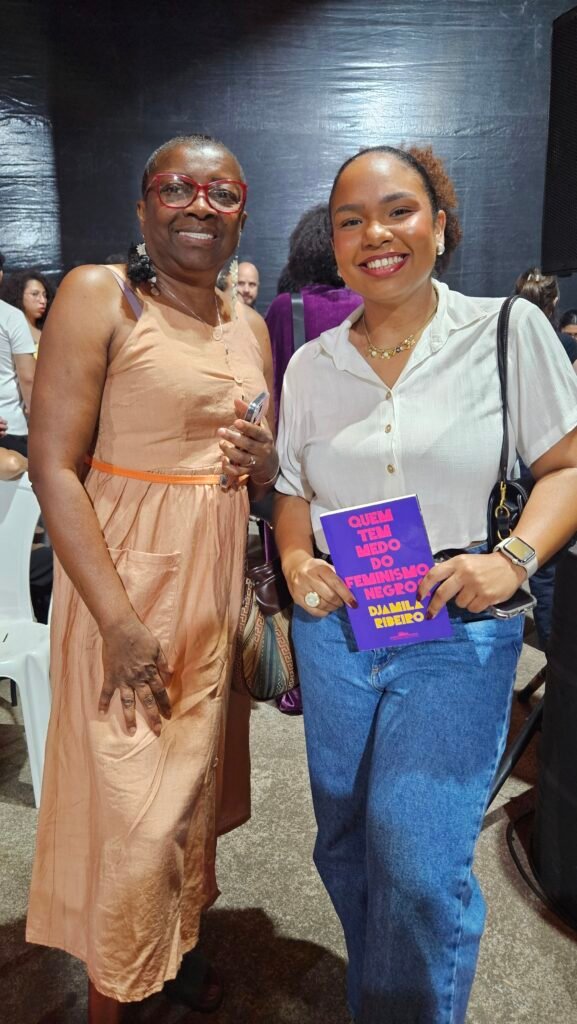
- Cristina Guimarães e Jaqueline Nunes
-
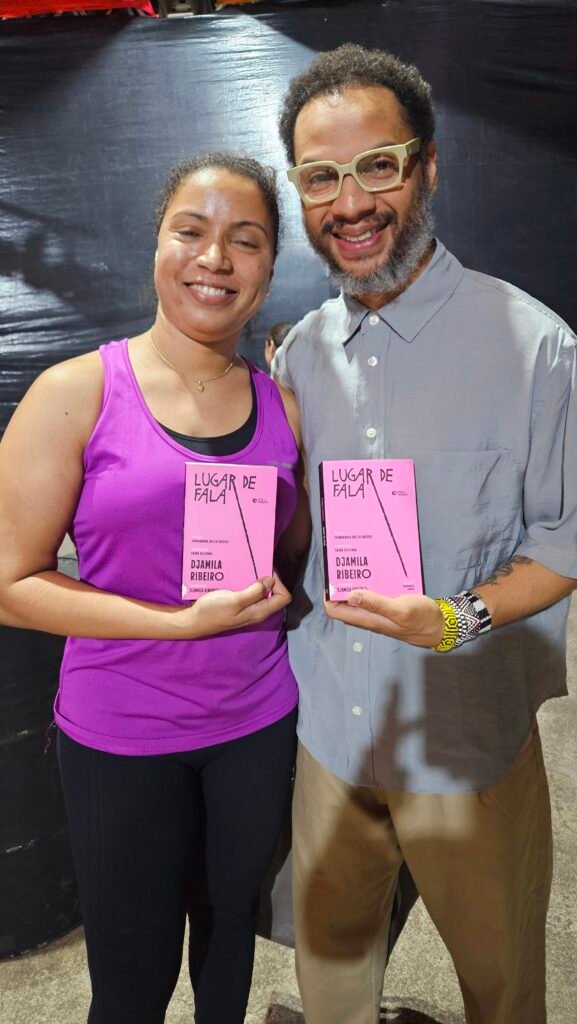
- André e a irmã Andrezza
Related articles
Djamila Ribeiro Joins the Brasília International Book Biennial This Saturday for a Panel on Democracy, Diversity, and Representation
Djamila Takes Part in Festa da Boa Morte in Cachoeira
In Belém, Djamila Ribeiro Presents New Edition of ‘Lugar de Fala’ and Joins Racial Equity Forum